
The Glyptothek is not only Munich’s oldest public museum, but also the only museum in the world dedicated exclusively to ancient sculpture. The name ‘Glyptothek’ is a modern artificial word. It is formed from the ancient Greek words ‘glyphein’ (to chisel) and ‘theke’ (storage), thus referring to a place where sculptures are kept. In front of the simple brick walls of the vaulted museum halls, Greek and Roman marble statues of the highest quality stand freely in the room and invite visitors to view them from all sides. Large windows provide daylight. On sunny days, visitors can therefore experience the marble figures in an atmosphere that could not have been more impressive even in sanctuaries or marketplaces of ancient cities.
The exceptional status of the exhibits is thanks to their founder and benefactor: Ludwig I (1786–1868), King of Bavaria from 1825 to 1848, wanted to acquire only high-quality antiquities for his museum. The fact that he actually succeeded in doing so was thanks to his Roman art agent Johann Martin von Wagner (1777–1858), who combined an unerring eye for ancient art with an ingenious scientific talent and great commercial skill. In this way, a collection of first-rate sculptures was created in just a short period between 1810 and 1820, which was then selectively enhanced by later acquisitions.
The time span of the antique originals ranges from the Archaic period (6th century BC) to Greek Classicism (5th/4th century BC) and Hellenism (3rd–1st century BC) to the Roman Empire and Late Antiquity (1st–5th century AD). In addition to sculptures that once adorned sanctuaries and public buildings and squares and served as funerary monuments, the Glyptothek’s marble sculptures also include numerous portraits of outstanding ancient poets, thinkers and rulers, from Homer to Plato, from Alexander the Great to Augustus and Marcus Aurelius.
History of the Glyptothek and its sculpture collection
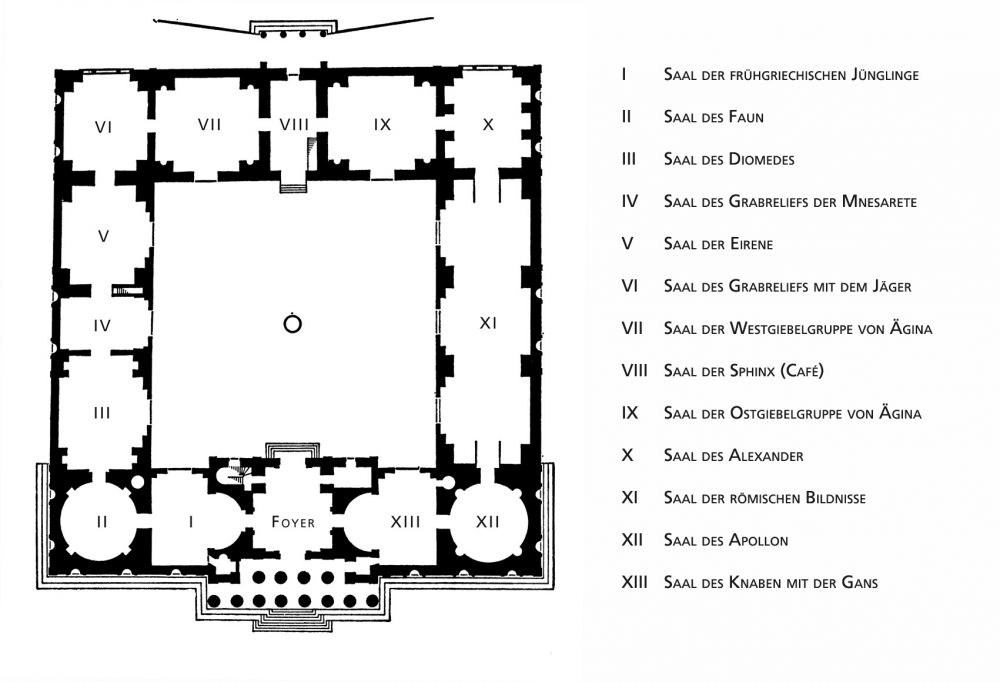
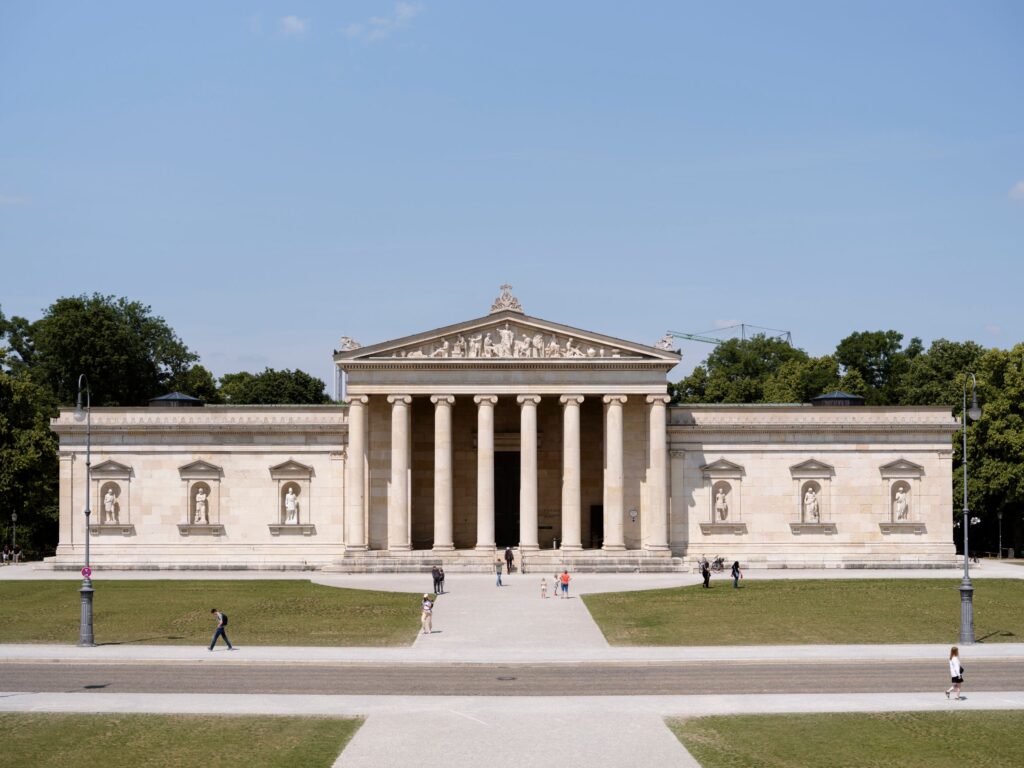
The Glyptothek was built between 1816 and 1830 by Leo von Klenze (1784–1864), court architect to Ludwig I. While the façade is modelled on Greek temple fronts, the interior rooms with their vaulted ceilings are reminiscent of Roman thermal baths. Fourteen halls surround a large square courtyard. Originally, they had coloured marble floors, colourful stucco walls and vaults, and received only sparse daylight through semicircular windows in the upper zone of the courtyard walls. The exhibits were moved to the walls and subordinated to the architecture. Klenze’s Glyptothek was less focused on the optimal presentation of the originals. Rather, it was intended to be a classicist Gesamtkunstwerk, or total work of art. For over 100 years, the museum stood in all its magnificent splendour. At the outbreak of the Second World War, it was closed and the antiquities were stored in monasteries. In the summer of 1944, the Glyptothek was hit by bombing raids and was then left to decay for years.
When reconstruction began in the 1960s, the concept Martin von Wagner had proposed at the time of construction was followed: he advocated sand-coloured walls, monochrome floors, simple pedestals and large windows. The figures were to be moved to the centre of the rooms. The Glyptothek, which reopened in 1972 with its slurry coating on the exposed brick walls, its blue-grey shell limestone floors and plinths, and its mighty inner courtyard windows, offers precisely this: a restrained but aesthetically tremendously effective setting for the outstanding quality of the antiquities.
Only a very few sculptures in the Glyptothek come from the old collection of the Wittelsbach electors and were originally housed in the Antiquarium of the Munich Residenz. The most important of these is the so-called Drunken Old Woman, a Roman copy of a famous Hellenistic original from around 200 BC. Most of the museum’s Greek and Roman marble works, however, were acquired by Ludwig I, who had become enthusiastic about ancient art during a trip to Italy in 1804/05. While still crown prince, he assembled an impressive collection of antiquities of the highest quality, which he paid for out of his own pocket, as he did the construction of the Glyptothek. Undoubtedly the most significant purchase was the acquisition of the pediment sculptures from the Temple of Aphaia in Aegina in 1812. The Aegina sculptures, which were supplemented by Bertel Thorvaldsen in Rome, were installed in the Glyptothek in 1827. After the Second World War, they were restored. Even today, they are still considered the undisputed highlights of the museum.
Some important works were only added to the Glyptothek’s sculpture collection during Ludwig’s reign as King of Bavaria between 1825 and 1848, with individual acquisitions finally taking place in the following twenty years until the end of his life. The collection has grown steadily since 1868, but remains manageable in size to this day.
Through his art collections and museum buildings, among which the Glyptothek took pride of place, Ludwig I wanted to make the city of Munich a centre of the arts, an ‘Isar Athens’, as he called it. From the outset, his goal was therefore to acquire only ‘works of outstanding beauty’ and, if necessary, to pay dearly for them. The collection is therefore unrivalled in terms of artistic quality.
Events
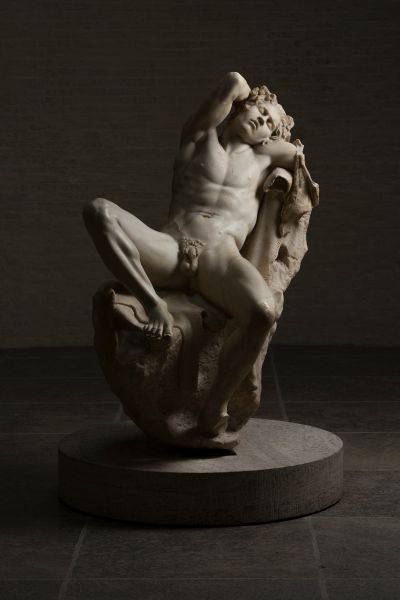
Glyptothek permanent exhibition: Masterpieces of ancient sculpture
The Glyptothek owes the exceptional status of its exhibits to its founder and benefactor: Ludwig I (1786–1868), King of Bavaria from 1825 to 1848, wanted to acquire only high-quality antiquities for his museum. The fact that this actually succeeded was thanks to his Roman art agent Johann Martin von Wagner (1777–1858), who combined an unerring … read more …
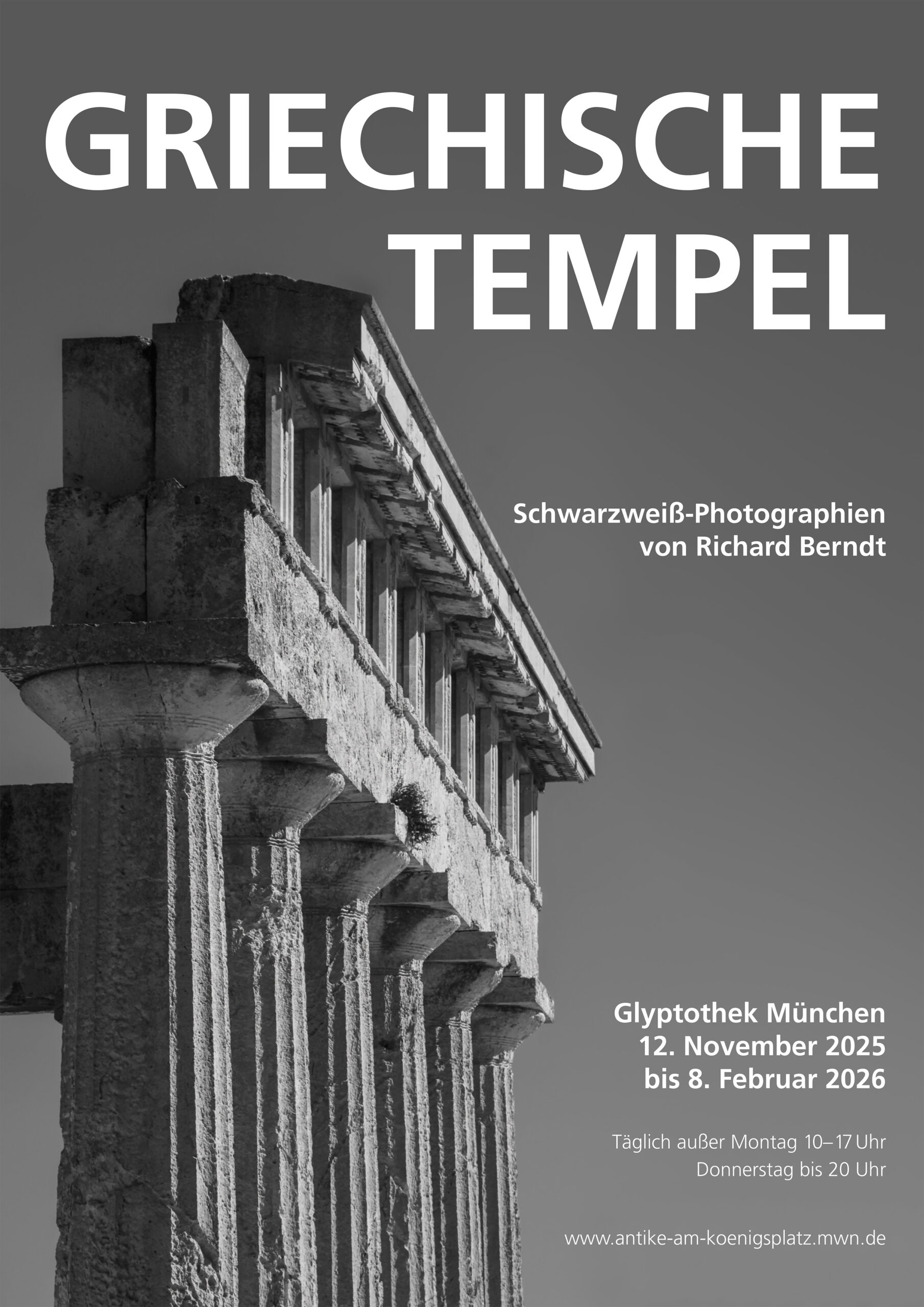
Special exhibition Glyptothek: Greek Temples. Black and white photographs by Richard Berndt
The Glyptothek has a tradition of displaying works of contemporary art alongside the ancient originals at regular intervals. In the exhibition “Greek Temples”, Richard Berndt, an ambitious amateur, presents his black and white photographs of ancient sanctuaries and takes us back to Greece and lower Italy. Ancient sculpture thus meets ancient architecture, which usually provided … read more …